

Sixteen teams. Five possible rounds. Three wins to advance, three losses to go home.
The LoL Worlds 2026 Swiss Stage is where the road to the League of Legends World Championship title becomes increasingly unforgiving. Unlike traditional group stages, teams face opponents with similar win-loss records, making every victory—and every defeat—matter.
But how does the format actually work? Why do some teams qualify after just three matches while others have to play five? And how are opponents selected?
This guide breaks down the Worlds 2026 Swiss Stage format, from match draws and qualification rules to the path toward the Knockout Stage.
Table of Contents
What Is the LoL Worlds 2026 Swiss Stage?
The Swiss Stage is a tournament format in which teams are repeatedly matched against opponents with the same win-loss record.
Instead of being placed in fixed groups, teams move through different record brackets based on their results.
At Worlds 2026:
- 16 teams compete in the Swiss Stage.
- Teams advance to the Knockout Stage after earning three match wins.
- Teams are eliminated after suffering three match losses.
- The Swiss Stage runs for a maximum of five rounds.
- Eight teams qualify for the Knockout Stage.
This structure rewards consistent performance while creating high-stakes matches between teams with similar tournament records.
How Do Teams Reach the Swiss Stage?
Worlds 2026 features 19 participating teams across the competition.
Fifteen teams enter the Swiss Stage directly through their qualification and seeding positions. Four other teams compete in the Play-In Stage for the final Swiss Stage spot.
The Play-In Stage uses a best-of-five, double-elimination bracket. Only one team advances.
That produces the 16-team field for the Swiss Stage.
The 2026 format broadly follows the previous year’s structure, with adjustments to the Play-In format and regional seeding.
How Does the Worlds 2026 Swiss Stage Work?
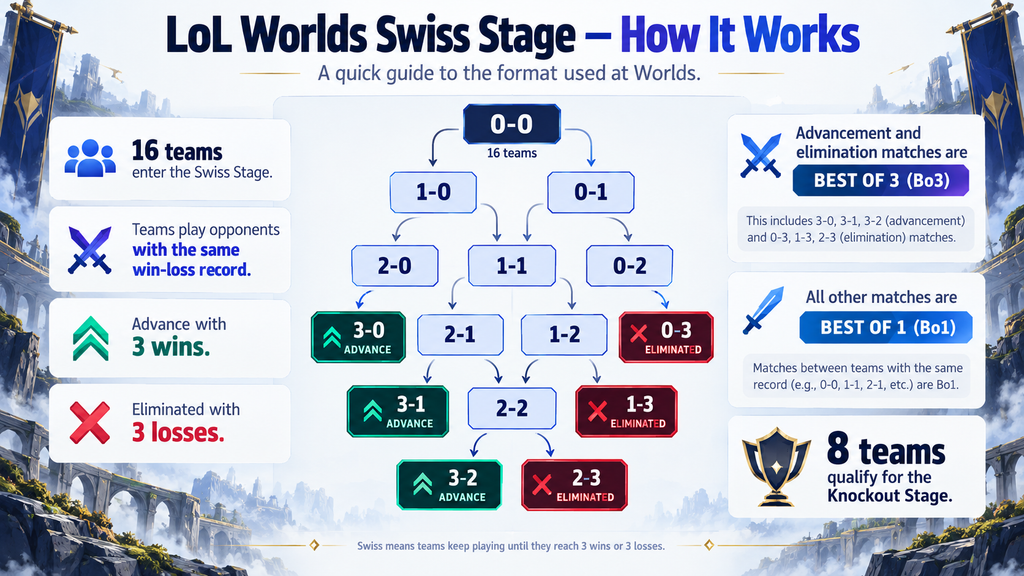
The easiest way to understand the format is to follow what happens after each match.
Round 1: Everyone Starts at 0-0
All 16 teams enter the Swiss Stage with no wins and no losses.
The opening matchups are determined by a draw using four seeding tiers.
For Worlds 2026, Tier 1 teams face Tier 4 teams, while Tier 2 teams face Tier 3 teams.
Teams from the same region cannot meet in Round 1.
After the opening matches, the field splits into two groups:
- Eight teams with a 1-0 record.
- Eight teams with a 0-1 record.
Round 2: Teams Face Opponents With Matching Records
The teams that won their opening matches are paired against other 1-0 teams.
The teams that lost are paired against other 0-1 teams.
After Round 2, there are three possible records:
| Record | What it means |
|---|---|
| 2-0 | Two wins, no losses |
| 1-1 | One win, one loss |
| 0-2 | No wins, two losses |
The pressure now rises sharply for teams on the edge of qualification or elimination.
Round 3: The First Teams Qualify or Go Home
Teams starting Round 3 at 2-0 can secure their third win and qualify for the Knockout Stage.
Teams at 0-2 face the opposite situation: another loss ends their Worlds campaign.
Meanwhile, teams at 1-1 continue competing for a better record.
By the end of Round 3, the first teams have advanced and the first teams have been eliminated.
Round 4: More Qualification and Elimination Matches
The teams still competing move into the next round based on their records.
Those at 2-1 are one win away from qualification.
Those at 1-2 are one loss away from elimination.
Every remaining match has significant consequences.
Round 5: The Final Deciding Matches
The final round is for teams that reach a 2-2 record.
Win, and the team finishes 3-2 and advances to the Knockout Stage.
Lose, and the team finishes 2-3 and is eliminated.
There is no additional group-stage tiebreaker required to decide whether these teams qualify. Their final match determines their fate.
Worlds 2026 Swiss Stage: Qualification at a Glance
| Record | Result |
|---|---|
| 3-0 | Qualifies for Knockout Stage |
| 3-1 | Qualifies for Knockout Stage |
| 3-2 | Qualifies for Knockout Stage |
| 2-3 | Eliminated |
| 1-3 | Eliminated |
| 0-3 | Eliminated |
A team does not need to go undefeated. It simply needs to reach three wins before reaching three losses.
That is why the Swiss Stage creates so many meaningful matches: teams keep competing until their qualification or elimination is decided.
How Are Swiss Stage Opponents Drawn?
The draw system is an essential part of the competition.
Round 1 Uses Seeding Tiers
The opening round uses four tiers, with Tier 1 matched against Tier 4 and Tier 2 against Tier 3.
Teams from the same region cannot be paired against each other in Round 1.
This creates an opening set of matchups shaped by tournament seeding rather than a completely unrestricted draw.
Later Rounds Match Teams With the Same Record
From Round 2 onward, teams face randomly drawn opponents with identical records.
For example:
- A 1-0 team faces another 1-0 team.
- A 1-1 team faces another 1-1 team.
- A 2-1 team faces another 2-1 team.
There are also two important restrictions.
No repeat opponents: Teams cannot face an opponent they have already played during the Swiss Stage.
Same-region matches are allowed after Round 1: Regional restrictions no longer prevent matchups once the opening round is complete.
These rules make the later draws particularly interesting. As teams qualify or are eliminated, the remaining pool of possible opponents becomes smaller.
Are Swiss Stage Matches Best-of-One or Best-of-Three?
Worlds 2026 uses a mixture of best-of-one (Bo1) and best-of-three (Bo3) matches during the Swiss Stage.
A best-of-one match is decided in a single game. A best-of-three series requires a team to win two games.
The distinction matters because a longer series allows more opportunities to adapt drafts and strategies.
As a general feature of the Worlds Swiss format, advancement and elimination matches use best-of-three series, while other Swiss matches are best-of-one.
For the exact match format and broadcast times on any given date, consult the official LoL Esports schedule.
Does Going 3-0 Give a Team an Advantage?
Yes.
Finishing the Swiss Stage with a perfect 3-0 record has an important benefit in the quarterfinal draw.
At Worlds 2026, the two undefeated Swiss teams are each paired with a team that qualified at 3-2.
The other four qualifying teams are drawn into the remaining quarterfinal matchups.
That means a team going 3-0 receives a distinct seeding advantage, although it is not guaranteed an easy quarterfinal.
A 3-2 team can still be extremely dangerous. The Swiss record reflects the path through the stage, not a definitive ranking of every team’s strength.
What Happens After the Swiss Stage?
Once eight teams have qualified, Worlds moves into the Knockout Stage.
The Knockout Stage uses a single-elimination bracket featuring quarterfinals, semifinals, and the Grand Final.
Every match is best-of-five.
Lose a series, and the tournament is over.
Win three knockout series, and a team becomes the world champion.
Unlike the Swiss Stage, there is no opportunity to recover from a knockout defeat.
Worlds 2026 Schedule and Locations
Worlds 2026 takes place in the United States across three host locations.
| Stage | Dates (U.S. local calendar) | Location |
|---|---|---|
| Play-In Stage | October 15–18 | Los Angeles, California |
| Swiss Stage | October 23–31 | Allen, Texas |
| Quarterfinals | November 3–6 | Allen, Texas |
| Semifinals | November 7–8 | Allen, Texas |
| Grand Final | November 14 | Brooklyn, New York |
The Swiss Stage, quarterfinals, and semifinals take place at the Credit Union of Texas Event Center in Allen.
The Grand Final is scheduled for Barclays Center in Brooklyn.
Note: Match dates can differ by one day for viewers in Asia because of time-zone differences. Always check the official broadcast schedule for your location.
Why Does the Swiss Format Matter?
The Swiss format changes the way teams experience an international tournament.
In a traditional group stage, teams know their opponents in advance. In the Swiss format, later opponents depend partly on results from earlier rounds.
That creates three interesting dynamics.
Every Early Match Changes the Road Ahead
Winning the opening match moves a team into the 1-0 bracket. Losing sends it into the 0-1 bracket.
The result changes both the team’s record and the pool of possible opponents.
Strong Teams Can Meet Before the Knockout Stage
Because teams are grouped by their current records, major contenders may face one another during the Swiss Stage.
Those matchups can significantly affect the knockout draw.
The Stakes Increase With Every Round
A team at 2-0 can qualify in its next match.
A team at 0-2 can be eliminated in its next match.
For fans, this makes the middle rounds especially compelling: every game can change who stays in the tournament.
Frequently Asked Questions
How many teams play in the Worlds 2026 Swiss Stage?
Sixteen teams compete in the Swiss Stage. The overall tournament features 19 teams, including four Play-In participants fighting for one Swiss Stage spot.
How many wins are needed to advance at Worlds 2026?
Three match wins. Teams qualify with a 3-0, 3-1, or 3-2 record.
How many losses cause elimination?
Three match losses. Teams are eliminated when they reach 0-3, 1-3, or 2-3.
How many teams advance to the Worlds 2026 Knockout Stage?
Eight teams advance from the Swiss Stage to the quarterfinals.
Can two teams from the same region face each other?
Not in Round 1. From Round 2 onward, same-region matchups are permitted.
Can two teams play each other twice in the Swiss Stage?
No. Repeat matchups are prohibited during the Swiss Stage.
When does the Worlds 2026 Swiss Stage begin?
The Swiss Stage begins on October 23 in Texas local time and continues through October 31.
Where is the Worlds 2026 final?
The Grand Final is scheduled for November 14 at Barclays Center in Brooklyn, New York.
Final Thoughts
The Worlds 2026 Swiss Stage is straightforward once you know the central rule:
Three wins to advance. Three losses to go home.
Everything else—the seeding tiers, same-record matchups, and quarterfinal draw—is designed around that path.
The format makes every match consequential while ensuring that the final eight teams have earned their place in the Knockout Stage.
For viewers, understanding the Swiss format adds another layer to every game. You are not just watching a team win or lose. You are watching its entire path through Worlds change.
Sources and Further Reading
- LoL Esports — Worlds 2026 Primer
- LoL Esports — MSI and Worlds Updates
- LoL Esports — Official Worlds Tournament Overview
Last reviewed: October 19, 2026. Tournament rules and schedules should be checked against official LoL Esports announcements for any subsequent changes.