For more than a decade, a familiar sight defined many Formula 1 overtakes: a driver closing to within one second of a rival, opening the rear wing on a straight, and attempting a pass.
That was DRS.
In 2026, Formula 1 introduced a different approach. The traditional Drag Reduction System disappeared, replaced by a combination of Overtake Mode, Active Aero, and new electrical energy-management tools.
But what actually replaced DRS? Does Overtake Mode make cars faster? And why can drivers now open their wings without being within one second of another car?
This guide explains the F1 2026 Overtake Mode vs DRS changes, including how the new systems work and what they mean for racing.
What Happened to DRS in F1 2026?
DRS was removed from Formula 1 under the 2026 regulations.
DRS, short for Drag Reduction System, had been used since 2011 to help drivers overtake by reducing aerodynamic drag on designated sections of a circuit.
Under the previous system, an eligible chasing driver could open part of the rear wing when sufficiently close to the car ahead.
Opening the wing reduced drag and helped the car achieve a higher speed on the straight.
For 2026, that function was split into two distinct ideas:
- Active Aero allows cars to adjust their front and rear wing configurations on designated straights, regardless of whether they are chasing another car.
- Overtake Mode provides an additional electrical-energy advantage to eligible drivers following a rival.
In other words, the adjustable-wing concept has not disappeared. The one-second-dependent overtaking advantage has moved from the rear wing to the power unit.
How Did the Old DRS System Work?
To understand the new regulations, it helps to remember what DRS was designed to achieve.
Formula 1 cars produce enormous aerodynamic downforce, which helps them corner at high speed.
However, downforce-generating aerodynamic surfaces also create drag. On a straight, that resistance limits maximum speed.
DRS reduced the drag produced by the rear wing.
The One-Second Rule
In race conditions, drivers generally needed to be within one second of the car ahead at a designated detection point to become eligible for DRS.
They could then activate the system in a specified DRS zone, subject to the applicable race-control conditions.
This created an advantage for the chasing driver.
Why Was DRS Controversial?
DRS helped create overtaking opportunities, but it also attracted criticism.
Some fans argued that it occasionally made passing too straightforward, especially when a car with DRS gained a substantial speed advantage on a long straight.
Others considered it a necessary response to the aerodynamic challenges of following another Formula 1 car closely.
The 2026 regulations do not eliminate the need for overtaking assistance. Instead, they change how that assistance is delivered.
What Is Overtake Mode in F1 2026?
Overtake Mode is a new electrical-energy-based overtaking aid introduced for the 2026 Formula 1 season.
Rather than opening a rear-wing flap, it gives an eligible driver access to additional electrical-energy deployment and recovery capabilities.
The system is designed to help a chasing car sustain a speed advantage and create an opportunity to pass.
How Do Drivers Qualify for Overtake Mode?
A driver must be within one second of the car ahead at the designated detection point.
Meeting this condition makes the additional electrical-energy profile available for the following lap.
The one-second rule therefore still matters in 2026, even though traditional DRS no longer exists.
How Much Extra Energy Is Available?
Formula 1’s official explanation states that Overtake Mode can provide an additional 0.5 megajoules (MJ) of energy recovery capacity, alongside an enhanced electrical power-deployment profile.
This helps an eligible driver sustain higher speed for longer.
It does not mean every activation produces the same speed increase. The benefit depends on factors such as the circuit, battery state, vehicle speed, and deployment strategy.
Can Drivers Use Overtake Mode Anywhere?
Unlike traditional DRS, Overtake Mode is not simply a wing-opening function limited to one designated straight.
The additional energy can be deployed strategically during the eligible lap, according to the applicable regulations and energy constraints.
Drivers and teams must decide where the extra deployment will be most effective.
A long straight may provide an obvious opportunity, but the most useful deployment point can depend on the race situation.
F1 2026 Overtake Mode vs DRS: Key Differences
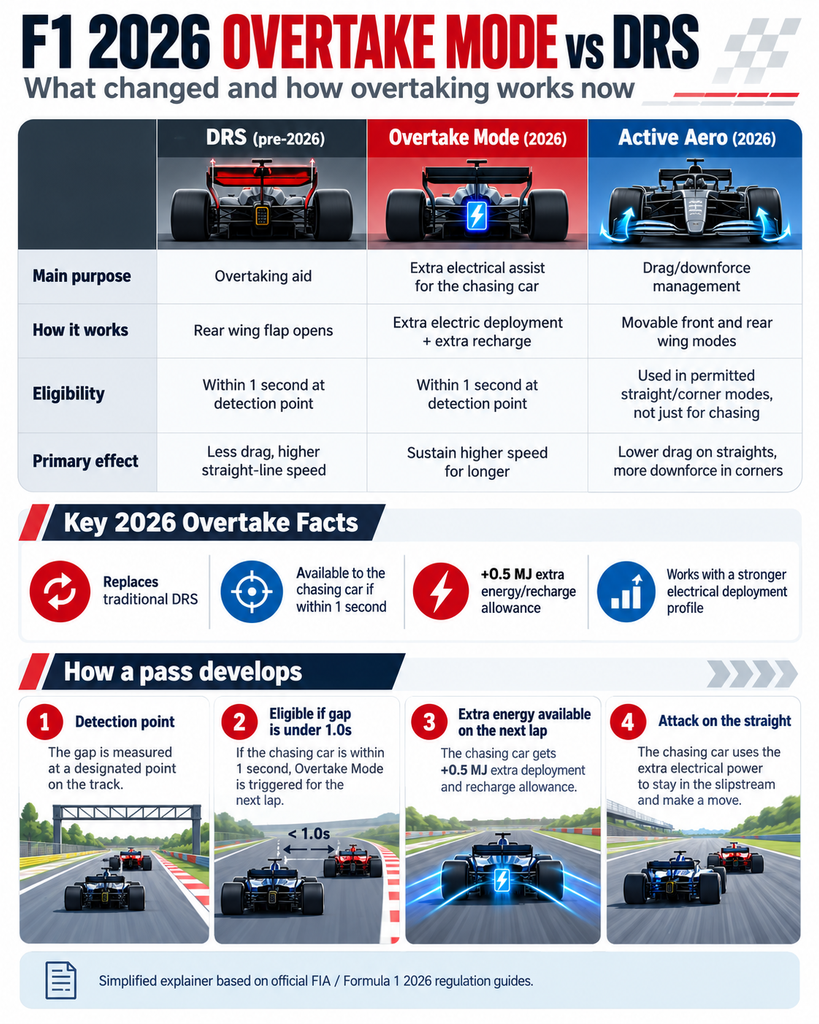
| Feature | DRS (Before 2026) | Overtake Mode (2026) |
|---|---|---|
| Primary purpose | Assist overtaking | Assist overtaking |
| Main mechanism | Reduce rear-wing drag | Provide additional electrical-energy capability |
| One-second requirement | Generally yes, at the detection point | Yes, at the detection point |
| Where the advantage is used | Designated DRS zones | Strategically during the eligible lap |
| Main performance effect | Reduced aerodynamic resistance | Additional power deployment and sustained speed |
| Separate from Active Aero? | No, DRS was the adjustable rear-wing system | Yes, Active Aero is a distinct system |
The most important difference is the source of the advantage.
DRS gave the chasing driver less drag. Overtake Mode gives the chasing driver additional electrical-energy capability.
This also changes what drivers must manage. Battery energy and deployment decisions have become central to overtaking strategy.
What Is Active Aero in F1 2026?
Active Aero is another major change in the 2026 regulations.
It allows elements of the car’s front and rear wings to change position to suit different sections of a circuit.
The system has two primary configurations:
Straight Mode: Lower Drag
On designated high-speed sections, the wings can move into a lower-drag configuration.
This reduces aerodynamic resistance, helping the car travel efficiently at higher speeds.
Unlike the old DRS system, access to this function does not normally depend on being within one second of a rival.
Corner Mode: More Downforce
In corners, the wings return to their higher-downforce configuration.
This provides the aerodynamic grip needed for braking, turning, and stability.
Changing between the two configurations helps teams balance straight-line efficiency against cornering performance.
Is Active Aero the Same as DRS?
Not exactly.
Both systems use movable aerodynamic elements to reduce drag, but they serve different roles.
DRS was primarily an overtaking aid available to eligible chasing drivers.
Active Aero is a broader aerodynamic-efficiency system, intended to help the new generation of Formula 1 cars manage drag and energy consumption.
Its use remains subject to designated zones and safety restrictions. It is not simply available in every corner or at every moment.
Overtake Mode vs Boost Mode: What’s the Difference?
These names sound similar, but they are not interchangeable.
Overtake Mode is a conditional advantage available to a chasing driver who satisfies the one-second requirement.
Boost Mode, by contrast, is a driver-operated electrical-energy deployment tool.
A driver can use Boost to attack or defend, provided sufficient battery energy is available and the relevant operating conditions permit it.
For example, a driver might use Boost to defend a position on a straight, even when they are not eligible for Overtake Mode.
Overtake Mode is specifically designed to help close the gap to a rival.
| System | What it does | Main restriction |
|---|---|---|
| Overtake Mode | Additional electrical-energy advantage for an attacking driver | Must meet the one-second detection requirement |
| Boost Mode | Driver-controlled energy deployment for attack or defence | Depends on available energy and operating rules |
| Active Aero | Adjusts front and rear wing configurations | Restricted to permitted zones and conditions |
| Recharge | Recovers electrical energy for later use | Depends on energy-management rules and driving conditions |
These systems can interact during a race, but each serves a different purpose.
Why Does Energy Management Matter More in 2026?
The 2026 Formula 1 regulations introduced major changes to hybrid power units.
The cars retain a 1.6-litre turbocharged V6 engine, but the electrical side of the power unit has a much larger role.
The maximum output of the MGU-K electrical motor increased from 120 kW to 350 kW.
This makes decisions about electrical deployment and recovery especially important.
A driver who uses too much stored energy early in a lap may have fewer options later.
Conversely, a driver who preserves energy may be able to mount an attack at a strategically useful moment.
What Is Recharge?
Recharge describes the recovery of electrical energy that can be stored and used later.
Cars can recover energy through braking and other permitted operating conditions, including certain lifting or part-throttle situations.
The details depend on the power-unit control strategy and circuit-specific regulations.
For viewers, the key point is that a driver’s straight-line performance now depends on more than engine power and aerodynamic drag alone.
How much energy a driver has—and when they use it—can change the outcome of a battle.
An Example of an Overtake Attempt in 2026
Imagine two drivers racing for fifth place.
The chasing driver approaches a designated detection point just 0.7 seconds behind the car ahead.
Because the gap is within one second, the chasing driver becomes eligible for Overtake Mode on the following lap.
The driver can then make strategic use of the additional electrical-energy capability.
Meanwhile, both cars may use Active Aero in permitted straight sections.
The leading driver may also deploy available Boost energy to defend.
The resulting overtake is not determined by a single rear-wing advantage.
Instead, it can depend on several interacting factors:
- How much battery energy each driver has available.
- Where the chasing driver chooses to deploy extra energy.
- How the leading driver responds.
- The length and layout of the straight.
- Braking performance and corner-exit speed.
This is a hypothetical example, but it illustrates why the 2026 system introduces a different strategic challenge from traditional DRS.
Does the New System Make Overtaking Easier?
Not necessarily in every situation.
Overtake Mode is designed to create passing opportunities, but overtaking remains dependent on the relative performance of the cars, their tyres, energy management, and the characteristics of the circuit.
The new regulations also introduce additional decisions for drivers.
A driver might use extra energy to attempt a pass immediately, or preserve some of that advantage for a later part of the lap.
A defending driver may need to choose between spending battery energy to hold position and saving it for subsequent laps.
That could produce more varied racing situations, but the effect cannot be reduced to a simple claim that every overtake is easier or harder than before.
Frequently Asked Questions
Is DRS completely gone in F1 2026?
Yes. The traditional DRS overtaking system was removed under the 2026 regulations. Movable wings remain through Active Aero, but they operate under a different framework.
Does Overtake Mode replace DRS?
Yes, in the sense that it is the new conditional overtaking aid. However, Overtake Mode uses additional electrical-energy capability rather than opening a rear wing.
Do drivers still need to be within one second?
Yes. The chasing driver must satisfy the one-second requirement at the designated detection point to become eligible for Overtake Mode.
Can every driver use Active Aero?
Generally, drivers can use Active Aero in permitted zones without needing to follow another car within one second. Restrictions can apply for safety, weather, and circuit-specific reasons.
Is Boost Mode the same as Overtake Mode?
No. Boost is a broader energy-deployment tool that can be used for attack or defence, whereas Overtake Mode is a conditional overtaking aid.
Why did F1 introduce Active Aero?
The 2026 power units rely much more heavily on electrical energy. Reducing drag on straights helps improve aerodynamic efficiency and manage energy use.
Final Thoughts
Formula 1 did not simply replace the DRS button with another overtaking button in 2026.
It introduced a more interconnected approach to racing.
Active Aero manages drag. Boost controls electrical deployment. Overtake Mode rewards a driver who gets close enough to challenge.
Together, these systems change how drivers attack, defend, and manage energy throughout a lap.
The fundamental objective, however, remains familiar: give drivers the tools to race closely and create meaningful opportunities to overtake.
For fans, understanding the difference between DRS, Overtake Mode, Boost, and Active Aero makes the new generation of Formula 1 much easier to follow.
Sources and Further Reading
- Formula 1 — The Beginner’s Guide to the 2026 Regulations
- Formula 1 — New Terminology for the 2026 Regulations
- FIA — F1’s New Era: 2026 Regulations Explained
- Formula 1 — All You Need to Know About the New Aerodynamics
Last reviewed: October 19, 2026. Some systems are subject to circuit-specific or weather-related restrictions, and technical regulations may be amended during the season.