How can an NBA team spend more than $200 million on player salaries when the league’s salary cap is much lower?
Every offseason, fans hear about cap space, Bird rights, the luxury tax, and increasingly, the first and second aprons. It can sound like a collection of complicated financial loopholes.
But the basic logic is easier to understand than it first appears.
The NBA salary cap is a soft cap, not a hard spending limit. Teams can exceed it under specific rules, but the more they spend, the more financial and roster-building restrictions they may face.
This guide explains how the NBA salary cap works, why teams can exceed it, and what the rules mean for free agency, trades, and championship contenders.
What Is the NBA Salary Cap?
The NBA salary cap is a league-wide threshold used to regulate how much teams can spend on player contracts.
It is determined each season under the NBA’s Collective Bargaining Agreement (CBA), which is negotiated between the league and the National Basketball Players Association (NBPA).
The most important distinction is that the NBA operates under a soft salary cap.
That means teams cannot freely ignore the cap, but they may exceed it using specific exceptions.
This differs from the NFL’s generally hard salary-cap system, in which teams must keep their cap accounting within the applicable limit.
How Much Is the NBA Salary Cap in 2026–27?
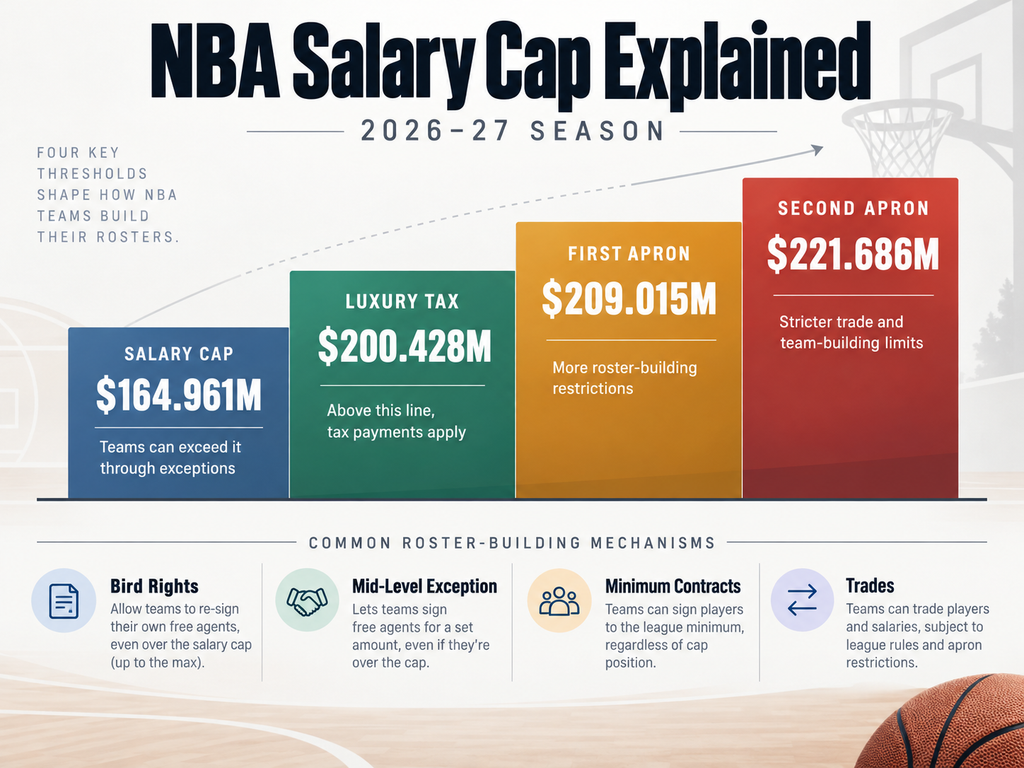
The NBA officially set the following thresholds for the 2026–27 season:
| Threshold | 2026–27 Amount |
|---|---|
| Salary Cap | $164.961 million |
| Luxury Tax Level | $200.428 million |
| First Apron | $209.015 million |
| Second Apron | $221.686 million |
These figures are updated each season.
The numbers also illustrate why the salary cap is not the same as a maximum payroll.
A team can spend above the salary cap without automatically becoming a luxury-tax team. Additional restrictions depend on its payroll level and the transactions it wants to make.
Why Can NBA Teams Go Over the Salary Cap?
NBA teams can exceed the salary cap because the CBA provides several exceptions.
These exceptions help teams retain existing players, fill roster spots, and make certain transactions even when they no longer have cap space.
For example, imagine a team already has $170 million in salary commitments.
If the league’s salary cap is approximately $165 million, the team is already above the cap.
That does not automatically prevent it from re-signing an eligible player using Bird rights or adding a player through a permitted exception.
However, the team cannot simply offer unlimited contracts to any free agent.
Being over the cap is allowed. How a team goes over it matters.
Cap Space vs. Salary Cap Exceptions
Cap space and exceptions are two different ways for teams to add players.
Cap space is the amount a team has available below the salary cap after accounting for the relevant payroll charges and cap holds.
Salary cap exceptions allow eligible teams to make certain signings or transactions without having enough cap room to cover the full amount.
Here is a simplified comparison:
| Method | How it works |
|---|---|
| Cap Space | A team uses available room below the salary cap |
| Bird Exception | An eligible team exceeds the cap to re-sign its own player |
| Mid-Level Exception | Qualifying teams use a designated exception to add players |
| Minimum Salary Exception | Teams sign eligible players to qualifying minimum contracts |
| Traded Player Exception | A qualifying trade creates a mechanism for a later salary acquisition |
The exact rules depend on the team’s payroll position and the CBA.
What Are Bird Rights in the NBA?
Bird rights are among the most important exceptions in NBA team building.
They generally allow a team to exceed the salary cap to re-sign an eligible player who has completed three qualifying consecutive seasons without losing his Bird rights.
Importantly, Bird rights can be preserved when a player changes teams through a qualifying trade.
This is one reason acquiring a player in a trade can be valuable even when that player’s contract is approaching expiration.
Teams may later have the ability to re-sign that player despite having little or no cap space.
Bird Rights vs. Early Bird vs. Non-Bird Rights
There are several related exceptions.
- Full Bird rights: Generally associated with three qualifying consecutive seasons, allowing eligible re-signings up to the player’s applicable maximum salary.
- Early Bird rights: Generally associated with two qualifying consecutive seasons, with more limited contract terms and starting-salary rules.
- Non-Bird rights: A more limited re-signing exception for players who do not qualify for the other two.
The distinctions matter because the available contract size and permitted terms may differ.
Do Bird Rights Allow Unlimited Spending?
No.
Bird rights do not override maximum-salary rules, roster limits, or other applicable CBA provisions.
They also do not erase luxury-tax obligations.
A team can use Bird rights to retain a star and still face major financial penalties or roster-building restrictions because of its total payroll.
What Is the Mid-Level Exception?
The Mid-Level Exception, commonly called the MLE, is a mechanism that allows qualifying teams to add players without ordinary cap space.
However, there is not one universal mid-level exception available to every team.
The applicable exception depends on a team’s salary position and other CBA restrictions.
For 2026–27, the NBA announced these amounts:
| Mid-Level Exception | 2026–27 Amount |
|---|---|
| Non-Taxpayer Mid-Level | $15.044 million |
| Taxpayer Mid-Level | $6.064 million |
| Room Mid-Level | $9.366 million |
The names can be confusing. Eligibility is not determined solely by whether a team pays luxury tax at the start of the season.
For example, using certain exceptions can trigger a hard cap at the first apron, while teams operating above the second apron face much tighter restrictions on adding players.
The figures above are exception amounts, not guarantees that every team can spend them.
What Is the NBA Luxury Tax?
The luxury tax is a financial system that applies when a team’s payroll, calculated under the relevant rules, exceeds the league’s tax threshold.
For the 2026–27 season, that threshold is $200.428 million.
A team above that level may owe tax payments, with rates depending on factors such as the amount above the threshold and whether it qualifies as a repeat taxpayer.
This means the cost of a roster can be greater than the player salaries alone.
The luxury tax is not the same as the salary cap.
For example, a team could have a payroll above the salary cap but below the luxury-tax threshold and therefore not owe luxury tax on that basis.
Tax revenue is handled under the league’s revenue-distribution rules, including distributions to eligible non-taxpaying teams.
What Are the First and Second Aprons?
The first and second aprons are additional payroll thresholds above the luxury-tax line.
Introduced under the current CBA framework, they create roster-building restrictions for teams with especially high payrolls.
First Apron Explained
For 2026–27, the first apron is $209.015 million.
Teams at or above this level face restrictions on certain roster-building transactions.
For example, the rules limit how much salary a team can acquire relative to the salary it sends out in certain trades.
Some methods of signing or acquiring players also cannot be used if they would cause a team to exceed the first apron.
This makes the first apron more than a financial milestone. It can affect which trades and free-agent transactions are legally available.
Second Apron Explained
For 2026–27, the second apron is $221.686 million.
The second apron imposes additional restrictions on the highest-spending teams.
Among the notable limitations, second-apron teams generally cannot combine the salaries of multiple outgoing players to acquire a more expensive player using the relevant salary-matching mechanism.
They also lose access to certain exceptions for adding outside talent.
Repeatedly remaining above the second apron can additionally create consequences for future first-round draft picks.
These rules are intended to limit the ways that the highest-spending teams can keep increasing their roster-building advantages.
Does the Second Apron Stop Teams From Re-Signing Their Stars?
Not necessarily.
Teams above the second apron can still use qualifying Bird rights to retain their own players, subject to applicable rules.
The bigger issue is often how difficult it becomes to add new talent around an expensive core.
This is why a team can have several highly paid stars and still struggle to improve its bench.
How Do NBA Salary Cap Rules Affect Trades?
NBA trades are about more than player ability.
Teams must also comply with rules governing the salaries they send out and receive.
A team with cap room can often absorb incoming salary using that room.
A team operating above the cap may instead need to rely on an applicable traded-player exception or salary-matching mechanism.
The permitted amounts depend on the team’s financial position and the specific transaction.
A Simple NBA Trade Example
Imagine Team A wants to acquire a player making $25 million per season.
Team A is already over the salary cap and has no exception that independently covers the incoming salary.
It might need to send players with sufficient outgoing salary to satisfy the applicable matching rules.
But the team cannot assume that combining several smaller contracts will always work.
If it is operating above the second apron, additional restrictions may prevent salary aggregation in certain trades.
That is why seemingly reasonable trades sometimes fail to comply with the NBA’s financial rules.
This example is illustrative. Actual trade eligibility depends on the CBA, salary calculations, timing, and team-specific conditions.
Why Do Rookie Contracts Matter So Much?
A productive player on a comparatively inexpensive contract can provide exceptional roster value.
This is particularly important for teams paying large salaries to established stars.
A strong player on a rookie-scale contract may contribute far more on the court than their salary suggests.
The team can use its remaining roster-building flexibility to add other contributors.
However, that advantage can change when the player becomes eligible for a more expensive second contract.
The team must then decide how the new salary affects its payroll, luxury-tax exposure, and apron restrictions.
This is one reason championship windows are often discussed in relation to contract timing.
How to Understand NBA Free Agency and Trade News
When a major NBA signing or trade is announced, ask four questions.
- Is the team under or over the salary cap? This helps determine whether ordinary cap space is available.
- Which exception or transaction mechanism is being used? Bird rights, a mid-level exception, or a trade mechanism can produce different outcomes.
- Is the team near the luxury-tax line or either apron? Its payroll position can affect the cost and legality of the move.
- What does the deal mean for future seasons? Long contracts and upcoming extensions can reduce future flexibility.
These questions offer a more useful way to understand a transaction than simply asking whether a player is overpaid.
Frequently Asked Questions
Is the NBA salary cap a hard cap?
No. The NBA generally operates under a soft salary cap, allowing teams to exceed it through qualifying exceptions. Certain transactions can nevertheless impose hard-cap restrictions at an apron level.
What is the NBA salary cap for 2026–27?
The salary cap is $164.961 million.
Can an NBA team spend more than $200 million on salaries?
Yes. Teams can exceed the salary cap through permitted mechanisms, although luxury-tax obligations and apron restrictions may apply.
What is the difference between the luxury tax and the second apron?
The luxury tax creates a financial cost for qualifying payroll above the tax threshold. The second apron imposes additional restrictions on particular roster-building transactions.
Can teams above the second apron sign players?
Yes, but their options are more limited. Certain permitted signings, including eligible minimum contracts and re-signings using Bird rights, may remain available.
Why do NBA trades need salary matching?
Teams without sufficient cap room or another applicable exception must follow salary-related trade rules. Those rules help regulate how much additional salary teams can acquire.
Do the NBA salary cap and apron amounts change every year?
Yes. The league announces new levels each season under the applicable CBA framework.
The Bottom Line
The NBA salary cap is not designed to prevent every team from spending above a single number.
Instead, it creates several layers of financial rules.
The soft cap controls ordinary spending flexibility. Exceptions allow certain additional moves. The luxury tax increases the cost of expensive rosters. The aprons restrict how the highest-spending teams can add talent.
Together, these rules shape how franchises sign stars, construct their benches, manage trades, and plan for the future.
For fans, understanding those four layers makes NBA roster news much easier to follow.
Sources and Further Reading
- NBA — 2026–27 Salary Cap Announcement
- NBA — Collective Bargaining Agreement Overview
- National Basketball Players Association — Current CBA
- NBA — CBA 101 Guide
Last reviewed: October 19, 2026. Salary thresholds and transaction rules are subject to the applicable Collective Bargaining Agreement and season-specific updates.